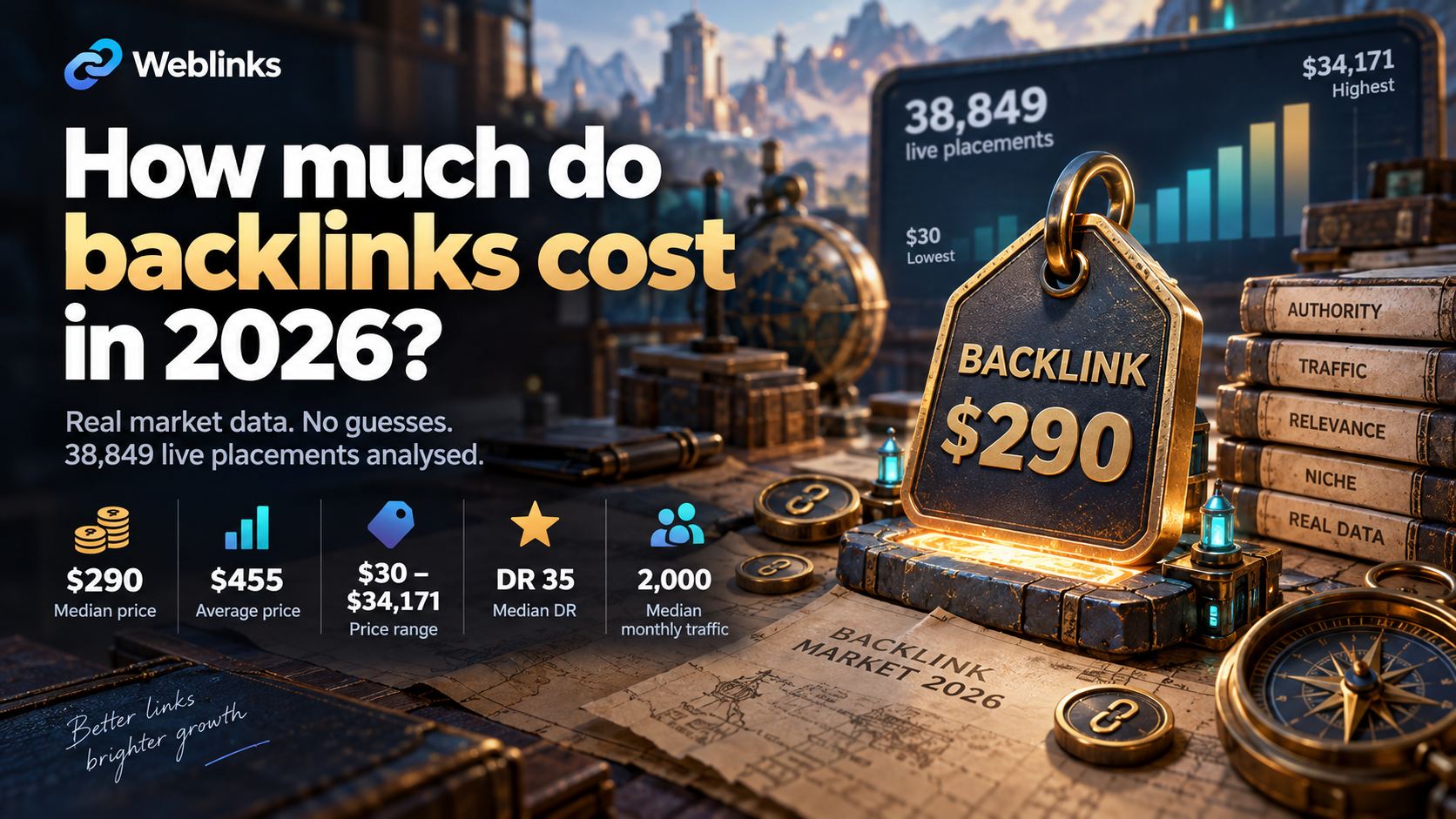
If you have ever asked how much backlinks cost, the honest answer is that most published figures are guesses. So instead of guessing, Weblinks analysed the backlink market itself, looking at what publishers across the industry actually charge in 2026, based on nearly 39,000 live link placements we track. The result is a clearer, data-backed picture of backlink pricing than any survey we have seen, and it exposes a few pricing myths that quietly cost buyers money. If you want to browse a large sample of that live market, it is searchable in our catalog of sites.
Everything below is drawn from 38,849 live publisher placements across the market. No third-party estimates, no rounded-off rumors, just real, current prices.
Median price: $290 · Average price: $455 · Range: $30 to $34,171 · Median Domain Rating: 35 · Median monthly traffic: 2,000
How much a backlink actually costs in 2026
Across the whole market, the median price of a single placement is $290, while the average sits higher at $455 because a small number of premium sites pull it upward. In practice, most real buying happens in a tighter band. Nearly 29% of all sites fall in the $100 to $199 range, making it by far the most common price point, followed by a strong cluster in the $500 to $999 range.
Number of sites by price band. Source: Weblinks market analysis · 38,849 live placements · 2026
The takeaway is that a healthy, relevant link on a legitimate site usually lands somewhere between $150 and $500. Anything advertised far below that is worth a hard look, and anything far above it needs to justify the premium with real traffic or authority.
The gap between the $290 median and the $455 average is worth understanding, because it tells you how the market is shaped. A relatively small number of premium sites, some priced into the thousands and one as high as $34,171, drag the average well above what a typical buyer pays. Use the median, not the average, as your mental anchor. If a vendor quotes you their average price to justify a number, they are quietly leaning on a handful of expensive outliers that have nothing to do with the site in front of you.
Why a higher Domain Rating does not mean a higher price
Here is the finding that surprises most people. If you sort these placements by Domain Rating and look at the median price in each band, the price barely moves across most of the range. From DR 10 all the way to DR 59, the median price stays wedged between roughly $235 and $314. Only once you reach DR 60 and above does it step up to around $420.
Median placement price by Domain Rating band. Source: Weblinks market analysis · 38,849 live placements · 2026
In other words, paying double for a DR 45 site over a DR 25 site often makes no sense, because the market prices them almost identically. The real jump in cost only kicks in at the genuine high-authority tier, and even there the premium is modest relative to the difference in strength.
What you are really paying for is traffic, not DR
If price does not track Domain Rating, what does it track. The answer is organic traffic. In our data, average monthly traffic climbs from a few thousand visits at low DR to more than half a million at DR 70 and above. Domain Rating is easy to inflate with cheap links, but real traffic is hard to fake, and experienced buyers have quietly shifted to using it as the true value signal.
This is the single most useful habit you can adopt from this data. When two sites cost the same, the one with meaningfully higher real traffic is almost always the better buy, regardless of which has the flashier DR number.
To make it concrete, a mid-tier DR 30 site in this market sample averages around 12,000 monthly visits, while the DR 70-plus tier averages more than half a million. That is where the price premium at the top actually earns its keep. You are not paying an extra hundred dollars for two more DR points, you are paying for an audience and a link that sits on a page real people visit.
Where the niche changes the price
Topic matters too. Sorting placements by subject shows a clear spread between the cheapest and most expensive niches. Broad IT and general-interest sites sit at the low end, while media, lifestyle and mixed news-and-media outlets command a noticeable premium.
Median placement price by niche. Source: Weblinks market analysis · 38,849 live placements · 2026
None of this means the pricier niches are overpriced. Media and lifestyle placements often come with stronger editorial trust and larger audiences. But it does mean you should benchmark within your niche, not against the global median, before deciding whether a quote is fair.
Red flags when a price looks too good
Only one placement in the entire sample of 38,849 sits below $50, and that scarcity is the whole point. When you see relevant links offered for a few dollars, the price is telling you what you are really getting. Watch for these warning signs before you buy anything priced well under the market:
- No real traffic. A tempting DR paired with a few hundred visits a month usually means the authority was built with links, not earned with content.
- Sites that sell everything. Publishers listing hundreds of outbound placements across unrelated topics are link farms in all but name, and Google treats them accordingly.
- Sitewide or footer links. A cheap link stamped across every page is a classic manipulation pattern, not an editorial mention.
- Instant, bulk delivery. Real editorial placement takes time. Offers promising dozens of links overnight are automated, low-quality, and risky.
A link that costs almost nothing and does nothing is not a bargain. On a young site, a single toxic placement can cost you more to clean up than a year of fair-priced links would have cost to earn.
The Weblinks verdict on getting fair value
Pulling it together, here is how Weblinks reads the market numbers when advising clients on what to pay:
- Anchor your budget to $150 to $500 per link. That covers the large majority of quality, relevant placements. Treat quotes far outside it as needing an explanation.
- Do not overpay for mid-range DR. The market prices DR 25 and DR 45 almost the same, so let relevance and traffic break the tie, not the rating.
- Buy traffic, not vanity metrics. Real organic visits are the value that price actually follows at the top end. Weight them heavily.
- Benchmark inside your niche. A $500 media placement and a $250 IT placement can both be fair. Compare like with like.
Backlink pricing in 2026 is far more rational than the horror stories suggest, as long as you know where the real value sits. The buyers who win are not the ones chasing the highest DR or the lowest price, but the ones matching relevant, well-trafficked sites to a fair market rate. That is exactly the judgement our team applies to every placement we vet, and it is the core of how our link building partnership protects clients from overpaying.