Guest posts vs niche edits is one of the most common questions we hear from clients deciding how to spend a link budget, and most answers online are pure opinion. We can do better, because Weblinks analysed what nearly 39,000 live publisher placements across the market actually offer and charge for each. The data settles a few arguments and makes the choice a lot clearer. If you are new to the mechanics of buying placements, our guide to guest posts that rank is a useful companion to this comparison.
Everything below comes from 38,849 live publisher placements across the market, split by whether the site offers a link insertion into existing content, which is what most people mean by a niche edit.
What each one actually is
A guest post is a brand-new article published on a host site, with your link placed naturally inside content written for the occasion. A niche edit, sometimes called a link insertion, adds your link into an article the site has already published and that may already have age, traffic and authority. Both can be legitimate, editorial links. The difference is whether you are paying for fresh content or for a placement inside proven content.
That distinction matters more than it first appears. With a guest post you control the topic, the angle and the exact context your link sits in, which is powerful when you want to shape how your brand is framed. With a niche edit you are a guest in someone else's finished article, so the link has to fit content that already exists. When the fit is natural, a niche edit borrows the authority and traffic that page has already earned. When the fit is forced, it reads as exactly what it is.
The price gap, in real numbers
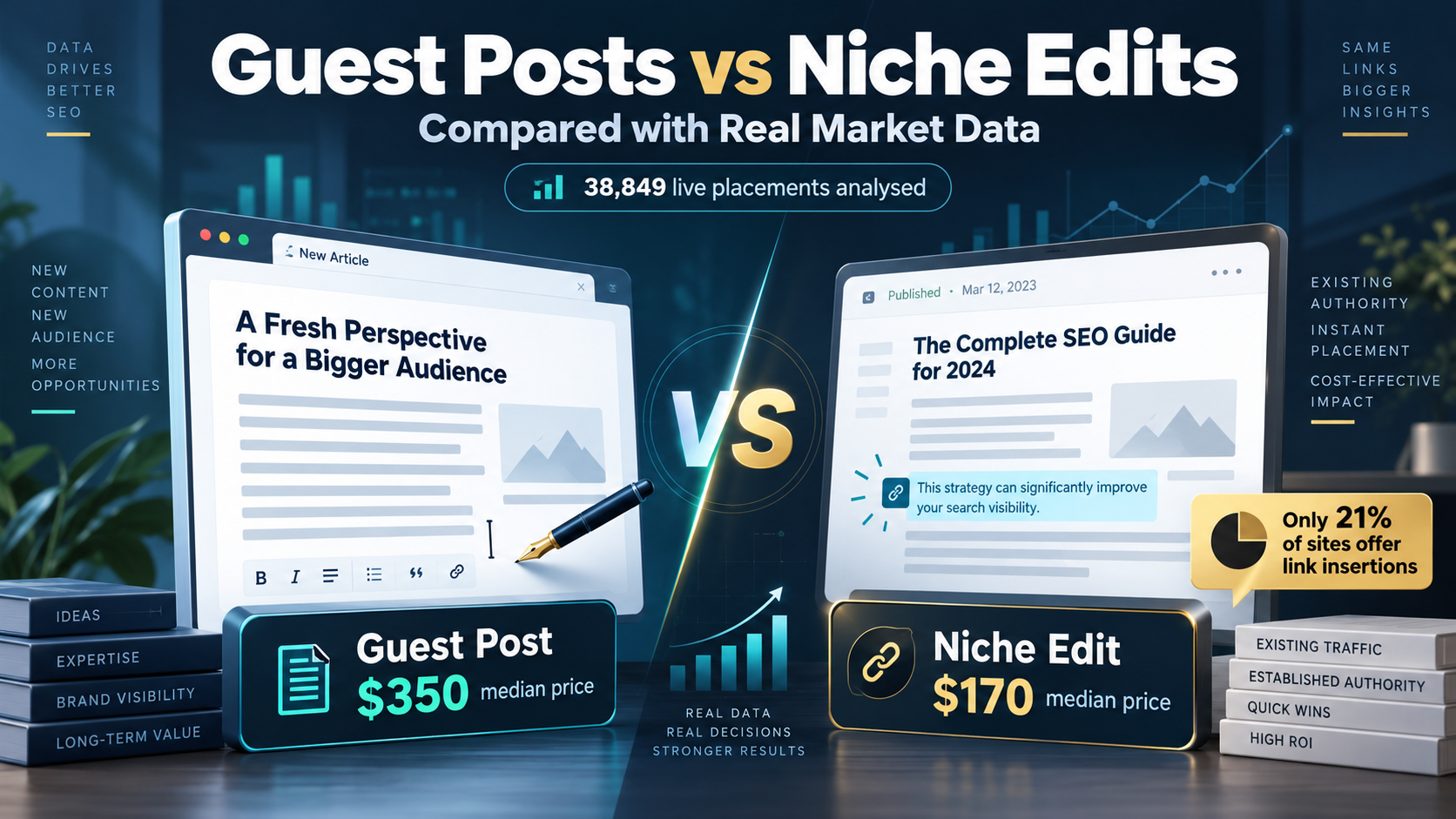
The clearest difference is cost. Across the market, the median price for a standard guest post placement is $350, while the median for a niche edit is $170. That makes link insertions roughly half the price of a full guest post, a gap that holds up consistently across the inventory.
Median price by placement type. Source: Weblinks market analysis · 38,849 live placements · 2026
The reason is simple. A niche edit asks the publisher for less work, since there is no new article to commission, write and edit. You are buying placement, not production, and the price reflects that.
Put in budget terms, the gap is significant. A $700 spend buys roughly two median guest posts, or around four median niche edits. On paper that makes insertions look like an easy win on volume. But volume is only an advantage if each of those four aged pages is genuinely relevant and worth being on, and in practice far fewer sites qualify. The right comparison is never two guest posts against four niche edits in the abstract, it is the specific, relevant targets available to you for each, at the price each publisher sets.
Availability across the market
Cheaper does not mean easier to get everywhere, though. Only about 21% of sites across the market offer link insertions at all, while the large majority accept guest posts. Many quality publishers simply will not alter older articles, which limits where niche edits are even possible.
Sites offering each placement type (niche edits = 21% of the market). Source: Weblinks market analysis · 38,849 live placements · 2026
This is the practical catch. A niche edit may be cheaper on paper, but if the relevant, high-quality site you want only accepts guest posts, the choice is made for you. Guest posts remain the more universally available option by a wide margin.
Speed, control and longevity compared
Price and availability are only part of the decision. The two methods behave differently on the things that affect results, and it helps to see them side by side.
| Factor | Guest post | Niche edit |
|---|---|---|
| Median price | $350 | $170 |
| Availability in market | Most sites | About 21% of sites |
| Editorial control | Full — you write the article | Limited — you fit existing content |
| Time to live value | Slower — new page must gain traction | Faster — page may already rank |
| Best for | Brand story, context, topical depth | Fast, cost-efficient authority into aged pages |
The risks each method hides
Neither option is risk-free, and the price gap does not tell the whole story. Each fails in its own way when it is done badly.
The danger with niche edits is relevance and intent. Because the link is dropped into existing content, it is tempting to force it into an article that is only loosely related, which produces an unnatural mention that adds little and can look manipulative. There is also the question of how the insertion is disclosed and whether the surrounding page is genuinely trusted rather than an aged domain repurposed to sell links. A niche edit is only as good as the page it lands on.
The danger with guest posts is scale and sameness. When the same thin article gets spun across dozens of low-effort blogs, the format collapses into spam, and Google has spent years devaluing exactly that pattern. A guest post earns its link only when the article is genuinely worth publishing on its own merits, on a site that would have accepted it even without the link.
In both cases the failure mode is the same root cause: treating the link as the product instead of the content around it. Get the relevance and quality right and either method is safe. Get it wrong and the cheaper option simply lets you make the mistake at a lower unit price.
Which one should you choose
The data points to a simple rule rather than a winner. Choose a niche edit when the ideal host page already exists, already has traffic, and the site allows insertions, because you get relevant authority faster and cheaper. Choose a guest post when you want control over the surrounding content, when you are building a narrative around your brand, or simply when the relevant site does not offer insertions, which is most of the time.
The strongest campaigns we run do not pick one and ignore the other. They use niche edits opportunistically where a perfect aged page exists, and guest posts as the dependable backbone that works almost anywhere. Matching the method to each target, rather than dogmatically favoring one, is what keeps cost down and quality up.
If you would rather have a team make that call target by target, using the same market data behind this article, that is exactly what our link building partnership does — and you can browse a large sample of the live market in our catalog of sites.