
Guest post outreach is still one of the most reliable ways to earn contextual backlinks, but the game has changed. The mass-mailed, copy-paste pitch that worked five years ago now lands straight in the trash. What still works in 2026 is targeted, genuinely useful outreach — reaching the right editor with a relevant idea and making their job easier. Done that way, a guest post gives you an editorial link inside real content, which is exactly the kind of signal search engines continue to reward (and the same foundation behind guest posts that actually rank).
This guide covers the full workflow — what outreach really is, why it still works, how to find and qualify prospects, and how to write a pitch that gets a reply instead of silence.
What Guest Post Outreach Actually Is
Guest post outreach is the process of contacting website owners and editors to propose writing a piece of content for their site, usually in exchange for a contextual link back to yours. It is part prospecting, part relationship building and part pitching. The link is the outcome, but the mechanism is a fair trade: you give the host a well-written, original article their audience will value, and in return your author bio or an in-content reference points to your site.
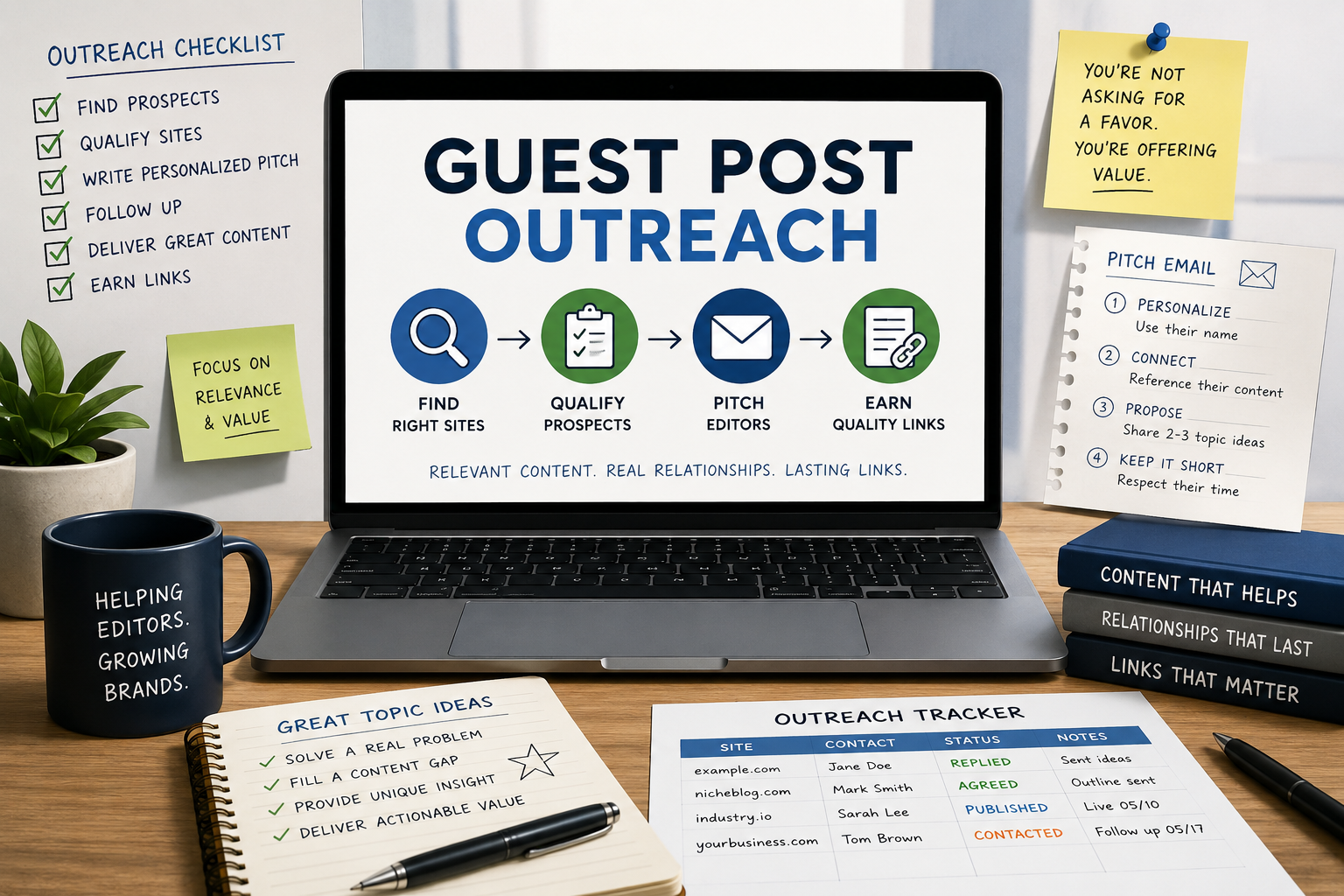
The reason this matters is that the quality of the placement depends almost entirely on the quality of your outreach. Pitch irrelevant sites with a generic template and you get low-value links or no reply at all. Pitch a closely related publication with a sharp, tailored idea and you earn a link that carries real topical weight.
Why Outreach Still Works After Google's 2026 Updates
Google's recent core updates have all pushed in the same direction — rewarding relevance, first-hand expertise and genuine editorial value over manufactured signals. That is good news for proper guest post outreach, because a link earned inside a relevant, editorially reviewed article is precisely what Google describes as legitimate.
The company's own guidance draws a clear line: links are fine when they are placed naturally within useful content, and they become a problem when they are bought at scale or mass-produced purely to manipulate rankings. You can read the current position in Google's spam policies documentation. Outreach that focuses on relevance and quality sits firmly on the right side of that line, which is why it has survived every update that wiped out cheaper tactics.
The mindset that wins
You are not asking a stranger for a favor. You are offering an editor free, high-quality content their readers will appreciate. Everything below flows from making that trade obvious and easy to say yes to.
How to Find the Right Sites to Pitch
The fastest way to build a prospect list is with search operators that surface sites openly accepting contributors. Combine your topic with phrases these pages tend to use:
- "keyword" + "write for us"
- "keyword" + "guest post guidelines"
- "keyword" + inurl:guest-post
- "keyword" + "contribute to our blog"
- "keyword" + "become a contributor"
Swap "keyword" for your actual niche. You should also look at where competitors publish their guest content — a backlink tool such as Ahrefs can reveal the exact sites linking to similar authors, and those same sites are often open to you. Save every prospect in a spreadsheet with the URL, the editor's name, their contact email and a one-line note on the angle you would pitch.
How to Qualify a Prospect Before You Email
A big list means nothing if the sites are weak or irrelevant. Before anyone earns a spot on your outreach list, run three quick checks.
Topical relevance
The site should sit close to your niche. A link from a tightly related publication carries far more weight than one from a general site that happens to accept guest posts. Relevance is the single strongest quality signal you control.
Real audience and authority
Check that the site actually gets organic traffic and has a reasonable authority profile. A smaller blog with genuine readers in your space beats a bloated domain that publishes anything and is ignored by Google.
Editorial standards
Look at what they already publish. If every post is a thin, link-stuffed article, a link from there does little and may even hurt. Sites with real editorial standards produce links that last.
A Guest Post Outreach Email That Gets Opened
Once your list is qualified, the email itself should be short, specific and centred on the editor's needs. A reliable guest post outreach email template follows four moves:
1
Use a real name
Address the editor or content manager directly. A named recipient beats a generic info@ address every time, and it shows you did your homework.
2
Open with them, not you
Reference a specific recent article of theirs and say something genuine about it. Prove you actually read the site before pitching.
3
Pitch two or three concrete titles
Give them ready-to-go topic ideas that fit their audience and fill a gap they have not covered. Make saying yes as easy as picking one.
4
Keep it short and follow up once
Respect their time — five sentences is plenty. If you hear nothing after a week, send one polite reminder and then move on.
In practice, a pitch that earns replies reads something like this:
Hi [Name], I really enjoyed your recent piece on [specific topic] — the point about [detail] matched what we have seen too. I would love to contribute a guest post to [site]. A few ideas your readers might like: [Title 1], [Title 2], [Title 3]. Each would be original and written specifically for your audience. Happy to send an outline if any of these fit.
Short, specific and built around the editor's audience — not yours.
How to Track and Scale Your Outreach
Outreach is a numbers game only once the fundamentals are right. To grow it without losing quality, treat every campaign as something you can measure and improve. Keep a simple tracker with each prospect's status — contacted, replied, agreed, published — so nothing slips and no editor gets pitched twice by mistake.
Watch two numbers above all: your reply rate and your placement rate. If replies are low, the problem is usually your targeting or your subject line. If people reply but few placements happen, the issue is your pitch or your content quality. Adjust one variable at a time and you will quickly learn what your niche responds to. Over a few campaigns, that feedback loop turns a cold list into a repeatable system — and it lets you scale outreach volume without slipping back into generic spam.
Mistakes That Get You Ignored
Most outreach fails for the same handful of reasons. Avoid these and your reply rate climbs quickly:
- Blasting a generic template. Editors spot a mass email instantly and delete it without reading.
- Pitching irrelevant sites. Volume without relevance wastes everyone's time and produces weak links.
- Leading with what you want. Opening with your link request instead of their needs kills the pitch.
- Sending thin content. If your draft is low effort, no outreach skill will save the placement.
- Over-following up. One reminder is persistence; three is spam.
Guest post outreach rewards patience and precision over volume. A focused campaign aimed at a few dozen well-qualified, relevant sites will almost always outperform a blast to hundreds of random blogs — and the editorial links you earn that way are the ones that keep working long after the campaign ends.
If you would rather have an experienced team handle the prospecting, qualification and pitching for you, that is exactly what our link building partnership is built for — so you get the placements without spending your week in an inbox.